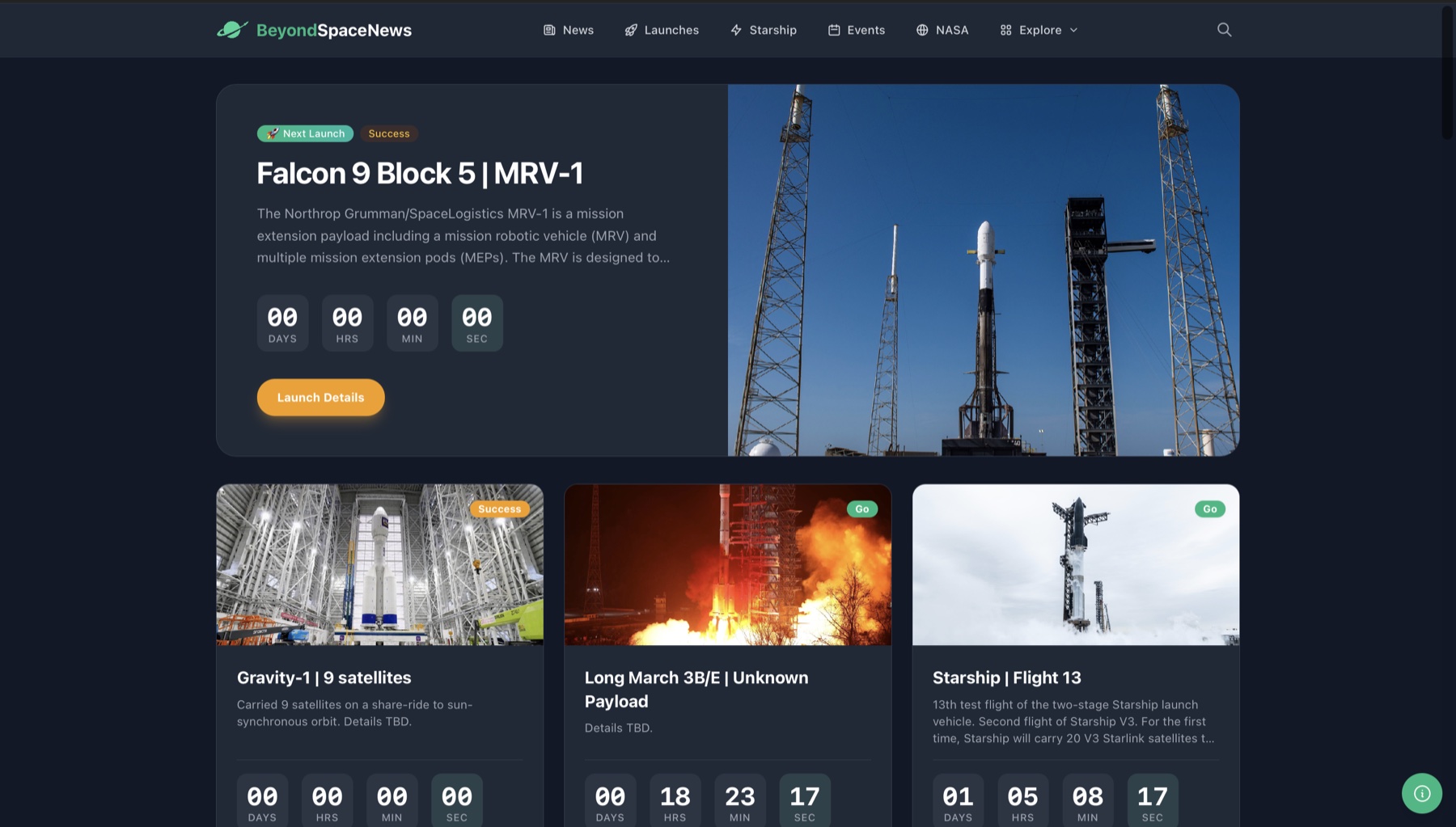
Turn fragmented space signals into one useful destination.
Spaceflight stories, mission data and live tracking information are spread across specialist publications and public APIs. BeyondSpaceNews brought those streams together without flattening them into a generic feed.
The portal was positioned as a resource for spaceflight news, launches and astronomical discoveries. Its Nuxt application combined editorial feeds with public science data and vehicle information, while server routes normalized the very different upstream sources.
News and blogs
A hero story and card-based feed surfaced current articles, with readable recency and direct links to original sources.
NASA Explorer
Dedicated views exposed Astronomy Picture of the Day and other NASA datasets in an approachable format.
ISS positioning
An internal API route transformed current ISS position data into a user-facing tracking feature.
Vehicles and launches
Appwrite-backed collections and Space Devs data supported vehicle and launch-related pages.
A magazine surface with dashboard depth.
The visual system paired large editorial heroes with structured card grids. A sticky multi-section navigation and explore menu made the broader data portal understandable, while dark-mode support kept long reading sessions comfortable.
Loading skeletons
Async views preserved page structure while server routes assembled content from caches or upstream APIs.
Human time
Time-ago components made fast-changing articles easier to scan than raw publication timestamps.
Explore by domain
News, NASA data, tracking and vehicle content stayed distinct without feeling like separate products.
Open the original
External articles opened in new tabs, keeping attribution and the source reading experience intact.
A resilient data layer behind the magazine.
BeyondSpaceNews was not a static blog. Nuxt Nitro routes orchestrated several APIs, checked stored data first and returned normalized responses to the Vue interface.
The common pattern was Appwrite-first: an endpoint attempted to read cached or curated documents, then fell back to an upstream API when data was missing or Appwrite was unavailable. Space Devs requests also passed through a separate caching server to work responsibly within upstream rate limits.
Internal API surface
- /api/blog/all
- /api/iss/position
- /api/nasa/mars-weather
- /api/vehicles/:id
Technology and sources
- Nuxt 3
- Vue 3
- TypeScript
- Tailwind CSS
- Nitro
- Appwrite
- NASA APIs
- Open Notify
- Spaceflight News API
- The Space Devs
Four years of building around changing data.
The service was shut down in 2025, but its deployed archive still demonstrates the interface and breadth of the original product.
Cache the dependency
External APIs shape product reliability. Appwrite storage and the dedicated Space Devs cache reduced unnecessary upstream calls and made fallback behaviour explicit.
Unify, then specialize
A consistent shell can hold editorial, scientific and live data experiences without forcing them into the same presentation.
Archived deployment
The final site remains viewable at bsnnews.netlify.app.